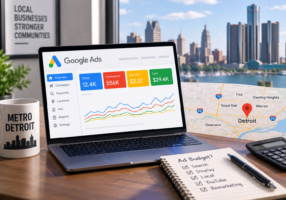
Short answer: Google Ads has no price. It is an auction, so you set a daily budget and pay per click, and the cost of a click depends on how many other businesses want that same search. The useful question is not what a click costs. It is what a lead costs, and you can work that out on the back of an envelope before you spend anything. This post shows you the math and tells you when the honest answer is that paid search is not your first move.
Why nobody will give you a number
Ask ten agencies what Google Ads cost and you will get ten versions of “it depends.” That is frustrating, and it also happens to be true. Here is why, in one paragraph.
When someone searches, Google runs an instant auction among advertisers who want that search. Your position and your price are determined by your bid and by how relevant Google judges your ad and landing page to be. That means the cost of a click for “emergency plumber Royal Oak” is set by how many plumbers are bidding in Royal Oak this month, not by any published rate card. It moves week to week. It moves by city. It moves by time of day.
What is fixed is the part you control. You set a daily budget. Google does not exceed your monthly limit. If you set fifty dollars a day, you spend roughly fifteen hundred a month and not more. So the real question is never “what does it cost,” it is “what do I get for the amount I am willing to spend,” and that is answerable.
The four things that set your cost per click
Customer value in your category. This is the dominant factor. Auction prices track what a customer is worth. A personal injury firm and a nail salon are not paying similar prices for a click, because one of them can profitably pay a great deal for a single new client and the other cannot. Legal, insurance, medical, cosmetic, and emergency home services sit at the expensive end for exactly this reason.
How many competitors want the same searches. Metro Detroit is a dense market. Bidding on “roofing contractor” across the whole metro puts you in an auction with everyone from Ann Arbor to Macomb County. Bidding on “roof repair Berkley” puts you in a much smaller room.
Your Quality Score. Google discounts your click price when your ad and your landing page genuinely match the search. This is not a rounding error. Two advertisers bidding the same amount can pay meaningfully different prices for the same position. It is also the single most controllable input on this list, and it is why sending paid traffic to your homepage is expensive in two ways: worse conversion and a worse price per click. A purpose-built landing page pays for itself twice.
Match type and negative keywords. Broad match without disciplined negatives is the most reliable way to waste a budget in this channel. If you sell commercial roofing and you are paying for clicks on “roofing jobs hiring” and “how to roof a shed,” your effective cost per lead is far higher than your cost per click suggests.
The math that actually matters
Forget cost per click for a moment. Here is the calculation to run before you spend a dollar.
Cost per lead = cost per click ÷ conversion rate
That is the whole thing. If clicks cost you eight dollars and four percent of clickers fill out a form or call, each lead costs two hundred dollars. If you improve the landing page and conversion goes to eight percent, the same clicks now produce leads at a hundred dollars. You did not touch the ad budget.
Then extend it one step:
Cost per customer = cost per lead ÷ close rate
If you close one lead in four, those two-hundred-dollar leads are eight-hundred-dollar customers. Now you can answer the only question that matters: is a customer worth more than eight hundred dollars to you over the life of the relationship? If yes, run the ads and scale them. If no, either the funnel needs fixing or this is the wrong channel.
Here is a worked example, and please read the numbers as illustrative arithmetic rather than Metro Detroit benchmarks, because your real figures will differ by category:
- Monthly budget: $2,000
- Cost per click: $10 → 200 clicks
- Conversion rate: 5% → 10 leads
- Cost per lead: $200
- Close rate: 30% → 3 customers
- Cost per customer: about $667
If your average customer is worth $3,000, that campaign is obviously worth running. If your average customer is worth $400, it is not, and no amount of optimization closes that gap. Running this calculation honestly is the fastest way to find out whether to proceed, and it takes five minutes.
How to get your own numbers instead of somebody’s averages
Published “average CPC by industry” tables are close to useless for planning, because they blend national data across markets that behave nothing alike. Get your own instead.
Open a Google Ads account, go to Keyword Planner, enter twenty keywords a real customer would type, and set the location to the cities you actually serve rather than the whole state. Google will show you search volume and a bid range for those exact terms in that exact geography. That is your real starting number, it is free to obtain, and it takes about fifteen minutes. The Google Ads Help Center walks through the tool if you have not used it.
Two things to watch while you are in there. Volume for hyper-local terms will look discouragingly small, and that is normal and fine; twelve searches a month for “emergency plumber Berkley” from people with a burst pipe is a better business than a thousand searches for “plumbing.” And the bid range Google shows is a range for a reason. Treat the top of it as your planning number.
Where a Metro Detroit budget usually goes wrong
Too broad a geography. The most common error we see. A single-location business in Troy targeting all of Metro Detroit is paying for clicks from people forty minutes away who will never drive to them. Radius targeting around your actual service area concentrates the same budget on people who might buy.
Too broad a keyword set. Ten well-chosen high-intent keywords will outperform two hundred loosely relevant ones at the same budget, every time. “Emergency AC repair” and “HVAC” are not the same search and should not share a campaign.
Sending traffic to the homepage. Your homepage is built to serve everyone. A paid click is one specific person with one specific problem. The gap between those two things is where budget disappears.
No conversion tracking. If you cannot see which keywords produced calls and forms, you are optimizing on impressions and clicks, which are proxies. This is genuinely common, including in accounts run by agencies, and it is worth verifying rather than assuming.
Turning it off after six weeks. Campaigns need conversion data to optimize. Stopping before you have any is spending the tuition and skipping the class.
Google Ads, Local Services Ads, and Meta are not the same purchase
Worth separating, because the pricing models differ in kind rather than degree.
Standard search ads charge per click. You appear when someone searches for what you sell, which is why intent is high and prices follow.
Local Services Ads charge per lead rather than per click, appear above standard ads for eligible service categories, and require background and license verification. For a lot of home service businesses this is a better first purchase than a search campaign, and it is frequently overlooked.
Meta ads charge for reach and interrupt people rather than answering them. That makes them better at demand creation and worse at capturing someone who needs a plumber right now. We compared the two directly in Google Ads vs Facebook Ads.
When we tell people not to run Google Ads
Three situations, and we would rather say so before you spend than after.
The website will not convert the traffic. If the site loads slowly, buries the phone number, or looks a decade old, paid clicks arrive and leave. Fix the website first. It is a one-time cost that improves every channel rather than a monthly cost that improves one.
Nobody answers the phone. This is not a marketing problem and we still raise it constantly. Paid search generates calls. If those calls go to voicemail during business hours, the budget is a donation.
The math does not work. If your average customer value is genuinely low and your category is genuinely expensive, paid search may never be profitable for you, and local SEO and reviews will produce better returns on the same money. That is an unglamorous answer and it is sometimes the right one.
A reasonable first ninety days

- Weeks 1 to 2. Keyword and geography research in Keyword Planner. Conversion tracking installed and verified before launch, not after. Landing page built or the best existing page identified and improved.
- Weeks 3 to 6. Launch narrow. Tight keyword set, tight radius, aggressive negative keyword list reviewed weekly. Expect the first fortnight to look inefficient. That is data collection.
- Weeks 7 to 12. Cut what is not converting, expand what is. By now you should be able to state your actual cost per lead rather than estimating it, which is the point at which the decision to scale becomes a business decision instead of a gamble.
Ninety days is roughly the point at which a search campaign in a competitive Metro Detroit category has enough data to be judged fairly. Judging it at thirty is judging the setup.
The summary
Google Ads cost whatever you decide to spend. Whether that money is well spent is determined by four things you control: how narrowly you target, how good your landing page is, whether you track conversions, and whether the underlying math between customer value and cost per customer actually works.
Run the arithmetic before you run the campaign. If it works, paid search is one of the few channels that can produce leads in the first week. If it does not work on paper, it will not work in the account.
MPH Marketing Solutions manages Google Ads and paid search in-house for businesses across Metro Detroit and Michigan, including Detroit, Southfield, and Sterling Heights. You own your ad account and your data. If you want us to run the cost-per-lead math for your category before you commit to anything, ask for a free consultation and we will tell you honestly whether the numbers work.